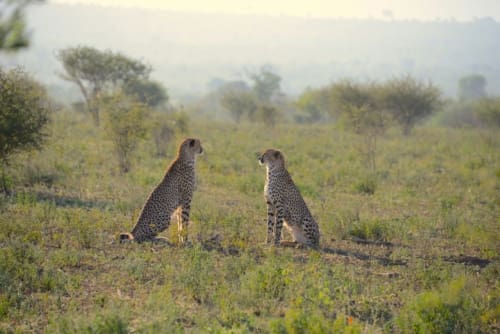
Lions are known for their power, leopards for their stealth, but what about Africa’s third big cat, the cheetah? As the fastest mammal on land, it’s a masterpiece of speed and agility. Yet those very adaptations mean that the cheetah isn’t built for strength in the same way as its larger cousins. Add to that its need for vast, open territory, and it’s clear why this species faces serious challenges in South Africa.
Today, the cheetah is Africa’s most endangered big cat. Its survival is under pressure from shrinking habitats, human-wildlife conflict, and fragmented populations.
At Kuzuko Lodge, conservation sits at the heart of who we are and so, our foundation has embraced the challenge of safeguarding this extraordinary animal.
Through our cheetah rewilding and breeding initiatives, we’re proud to play our part in helping to secure a future for these iconic cats, while giving our guests the unforgettable chance to witness conservation in action.
Managing The Metapopulation
One of the greatest challenges facing cheetahs today is the fragmentation of their habitats. Across Africa, cheetahs are confined to isolated reserves or patches of land, with little opportunity to roam freely or mix genetically. This creates the risk of inbreeding and weakens the species’ long-term chance of survival.
To address this, conservationists manage cheetahs as a metapopulation. In other words: a network of distinct, geographically separated groups that are treated as one unified population.
By carefully relocating individuals between reserves, we help ensure genetic diversity and strengthen the resilience of the species. While this requires collaboration across countries and organisations, it is an effort that is yielding results. In fact, the managed cheetah population is currently the only growing wild cheetah population in the world!

Rewilding Cheetahs at Kuzuko Lodge
At Kuzuko, we have proudly rewilded 18 cheetahs to date.
As you might imagine, rewilding is a gradual process, beginning with a managed release. Newly arrived cheetahs are placed in a safe enclosure (called a boma) where they can acclimatise to their new surroundings. Once they have adjusted, they are released into the wider reserve where they can roam freely.
This careful approach ensures that each rewilding is a step towards strengthening the metapopulation and preserving Africa’s cheetahs for future generations.
Our work is not only about numbers, but about the individual lives of the animals we care for. Most recently, we rewilded and relocated an orphaned family of four cheetah brothers, whose mother was tragically killed while hunting. Their successful adjustment into the wild stands as a testament to both resilience and the power of conservation collaboration.
Ask your guide at Kuzuko to tell you more about the very special story of Aero and Storm!

Why It Matters
Cheetahs are more than just beautiful animals – they are keystone predators that help maintain the balance of ecosystems. Their decline is a signal of broader environmental pressures, but their survival offers hope. By supporting the metapopulation project and investing in rewilding, Kuzuko contributes to the only expanding wild cheetah population on the planet.
Our efforts also extend beyond the reserve: By supplementing other populations and reintroducing cheetahs to areas where they have disappeared, we are helping to secure a future where this species continues to run wild across Africa.
Stay With Us
For guests of Kuzuko Lodge, a safari is more than a chance to see the Big Five, it’s an opportunity to engage with meaningful conservation. Watching a cheetah sprint across the plains or spotting a cub at play takes on even greater significance when you know the story behind their survival.
By visiting Kuzuko, you are directly supporting these efforts, ensuring that cheetahs, and the ecosystems they sustain, remain part of Africa’s living heritage.
To book your stay, visit our website, make use of our online booking platform, or contact our reservations team directly at reservations@kuzuko.com.
We can’t wait to welcome you to the Eastern Cape and have you experience these big cats up close.